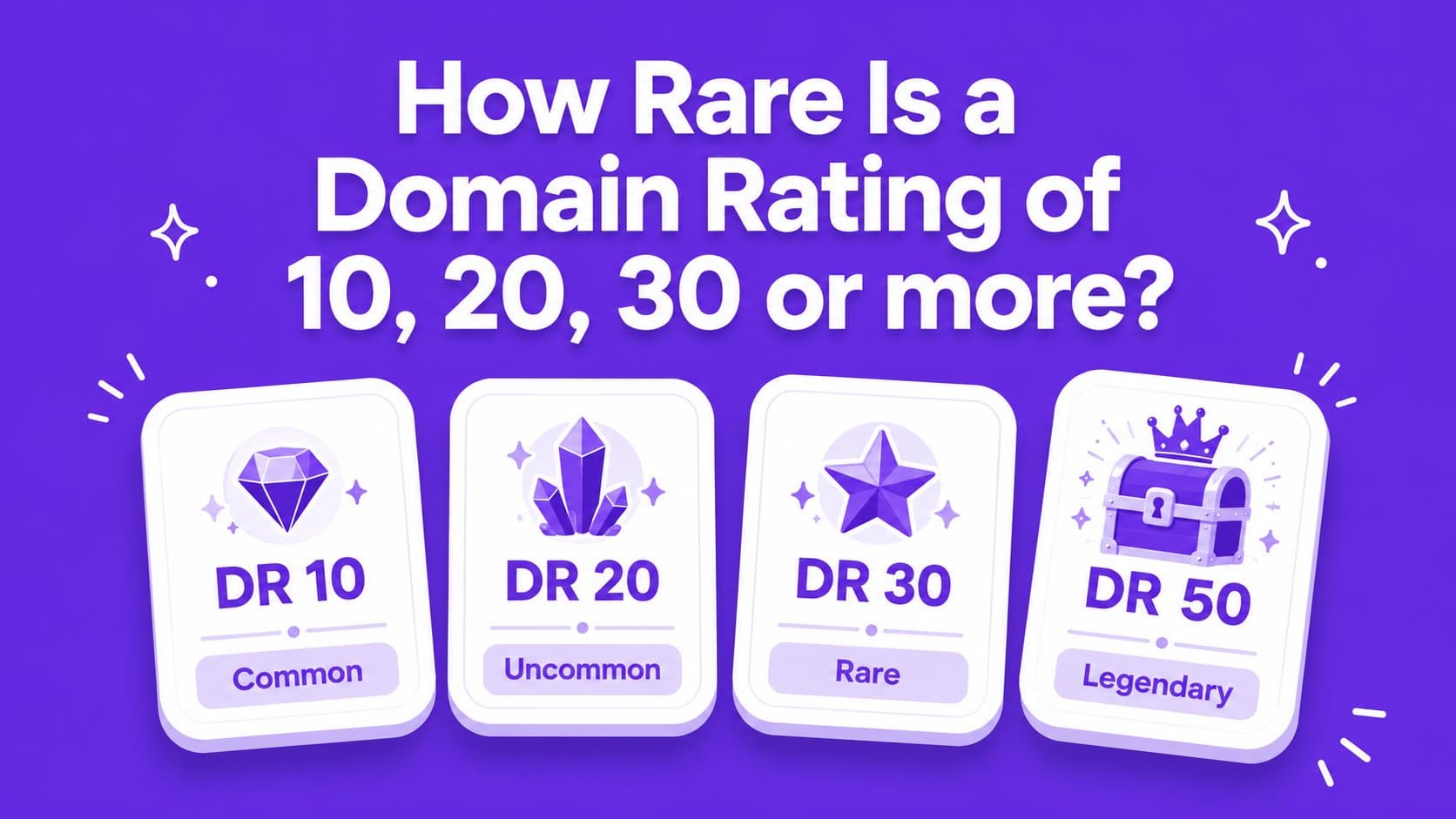
How Rare Is a Domain Rating of 10, 20, 30 or more?
What percentile is your Domain Rating in? A look at how DR is distributed across the web, with benchmarks for indie builders and what each tier unlocks.

Most websites on the internet sit below DR 10. If you're above that, you're already ahead of the pack. Above DR 20, you're in roughly the top 5%. Above DR 50, you're in elite company.
This post lays out where each tier sits, what it unlocks, and how to find your own bracket.
How DR is distributed across the web
Ahrefs has indexed hundreds of millions of domains. The shape of the distribution is heavily skewed: most domains have almost no backlinks, a small slice has many, and the very top has astronomical amounts.
Rough estimate of where domains land:
Sources: Ahrefs' published research on DR distribution across the open web (their crawl indexes hundreds of millions of domains), cross-referenced with DR readings tracked on VerifiedDR.com across LaunchPanda's monitored indie products.
These are rough brackets, not exact numbers. The point: DR 20 already puts you in the top 5% of the web. You don't need DR 80 to compete.
What each tier actually unlocks
The percentile is interesting. What it unlocks is more useful:
- DR 0 to 10: You can rank for keywords nobody searches. Useful for proof of concept, not for traffic.
- DR 10 to 20: You can start ranking for low-competition keywords. This is where the first trickle of organic traffic shows up.
- DR 20 to 30: Google takes your new pages seriously. You can target medium-volume keywords if your on-page SEO is right.
- DR 30 to 50: You can outrank lazy competitors on competitive keywords. You no longer need to fight for every page.
- DR 50+: You can rank for almost any keyword in your space if you write a decent post about it.
The jump from DR 10 to DR 20 is the most valuable in your career as an indie builder. It's the difference between Google ignoring you and Google considering you.
Why higher tiers compound
DR scales logarithmically, so each tier is much harder to enter than the one below. A single dofollow link from a DR 80 site might add more to your DR than 50 links from DR 5 sites combined.
This is also why the top 0.01% is so sticky. Once you're in that bracket, every new link you earn is worth more than every link in the brackets below. The rich get richer.
For indie builders, this works the other way too: clearing DR 20 quickly is the cheapest leverage you'll ever have on your site. After that, growth slows down naturally and you can shift your focus.
How to find your own percentile
The Ahrefs free Domain Rating checker gives you your current DR in 5 seconds. Drop in your domain, read the number, map it to the table above.
If you'd rather see the math, VerifiedDR shows the receipts: every backlink, its source, and how much each contributes.
The fastest way to climb a tier
The single biggest lever on DR is the count of unique referring domains. Each dofollow directory submission adds one. Twenty submissions in a month is roughly the difference between DR 5 and DR 20.
We keep a vetted list of the best free directories ranked by their own DR. Submit to them top down.
If you'd rather not do this manually, Auto Launch handles 30, 50 or 100 vetted directories in a week, the average product gains +19 DR inside the first 30 days. That's most products moving from the bottom 50% to the top 5% in a month.
Liked this article?