SEO vs AEO vs GEO: What's the Difference?
SEO, AEO, and GEO sound interchangeable but do different jobs. Here's the difference between them, and which one to focus on to get found in 2026.

In the SEO world, three acronyms are now fighting for your attention: SEO, AEO, and GEO. They sound interchangeable. But they're not. Here's the one-line version: SEO gets you ranked on Google, AEO gets you quoted as the answer, and GEO gets you cited inside AI tools like ChatGPT. In 2026, the one you should optimize for depends on the tool or service you're building, so it's worth knowing where to spend your time.
A new world
For well over twenty years, before the LLM revolution, "getting found online" meant one thing: ranking on Google. You picked your keywords, built some backlinks, waited a few months, and hoped to rank as high as possible.
That playbook is breaking, at least as your only focus now AI has walked onto the field. People now ask ChatGPT, search Perplexity, and read Google's AI Overview without ever clicking through to a single website. The question has quietly shifted from "how do I rank?" to "how do I get mentioned when a machine answers for me?"
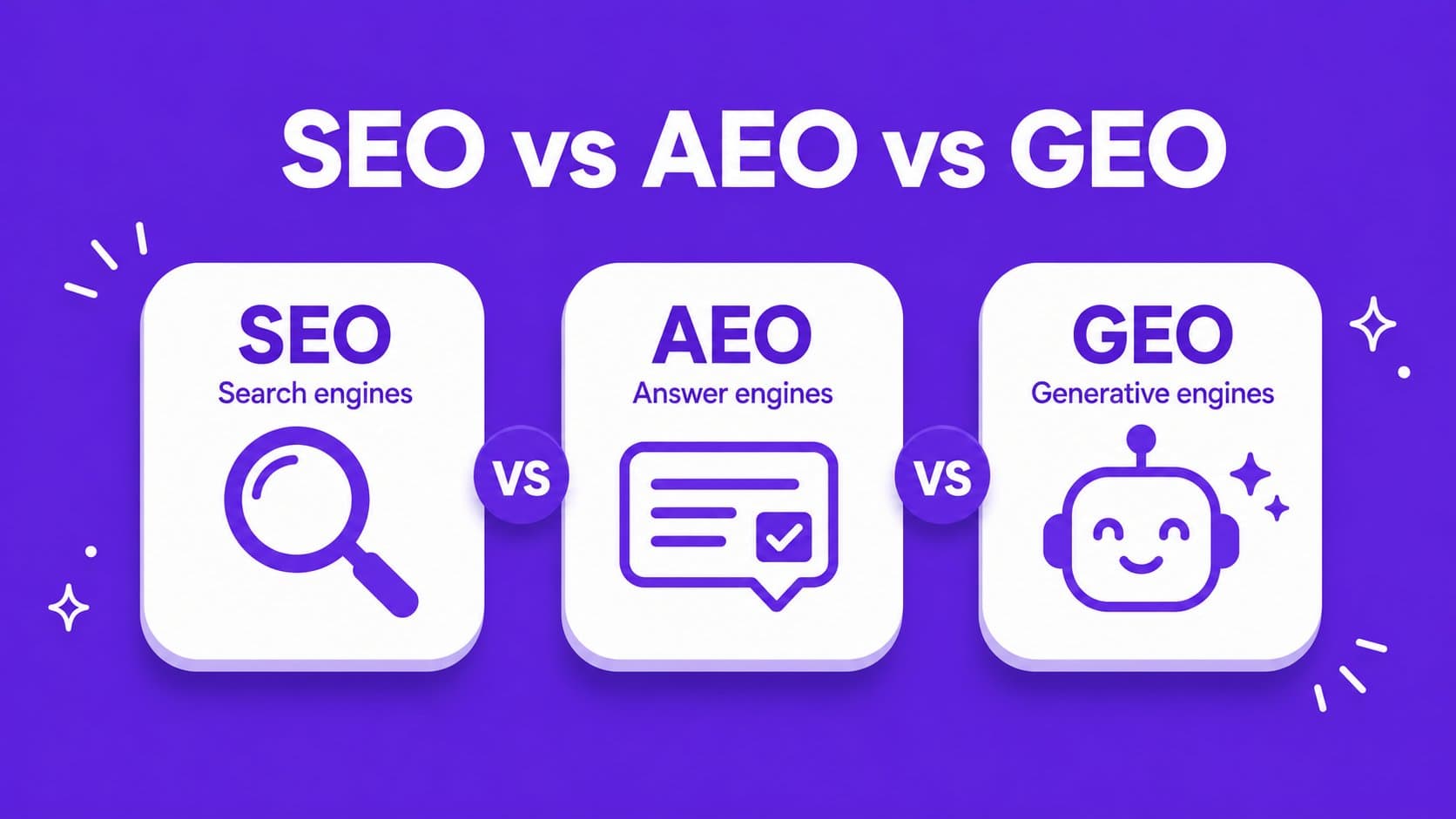
The table below gives a brief explanation of each.
SEO: the foundation
Search Engine Optimization is the one you probably already know. It gets your pages to rank in a traditional search engine's list of results, and for most people that engine is Google. How it works has been stable for years. You find the keywords your audience is searching for, then write content that answers them. From there you build backlinks from other sites so Google trusts you, keep your page structure clean and fast so it can crawl you, and grow domain authority over time.
SEO isn't dead, and don't let anyone tell you it is. It's the base layer everything else is built on. If Google can't understand your content, neither can the AI engines that increasingly learn from it. For the full argument, read Is SEO still relevant in the age of AI?.
AEO: optimizing to be the answer
Answer Engine Optimization is a smaller shift than GEO but an important one. Instead of ranking in a list, you become the answer.
Think about the last time you asked Siri a question, saw a boxed answer at the top of Google before any of the real results, or read a "People Also Ask" panel. The point is, people don't click through a list of links to find an answer anymore. They just want the answer. One source gets pulled out and served directly, and you want yours to be that one.
That's what you optimize for with AEO:
- Structured data and schema markup so machines can parse you cleanly
- Concise question-and-answer formatting that matches how people actually ask
- Clear headings with the direct answer up top, not buried in paragraph six
- Voice-friendly phrasing for assistants that read one answer aloud
The catch is that AEO is often zero-click. You win the visibility, but the reader may never visit your site. You're trading traffic for authority.
AEO is also getting less relevant by the month. The classic single-source answer box is being pushed down by Google's AI Overview, the AI-written summary that now sits at the very top and pulls from many sources at once. That's GEO territory, not AEO. So while being the one quoted answer still matters, Google itself is shifting the prime real estate toward generated answers, which makes GEO the bigger bet going forward.
GEO: optimizing for AI answers
Generative Engine Optimization is the newest of the three, and the one most founders are sleeping on (especially outside of the tech scene).
GEO is about influencing what large language models say and cite when they generate an answer. When someone asks ChatGPT "what's the best tool for launching a product?" and it lists five options, GEO decides whether your name is in that list.
There's no ranking here. You're either mentioned in the generated answer, or you're invisible. This is what to focus on:
- Brand mentions across the web, not just links, actual mentions in context. Social platforms like Reddit have become increasingly important for this
- Citations from authoritative sources the models already trust and pull from
- Clear, factual content an LLM can lift without ambiguity
- Presence wherever these models source their answers, from reputable roundups to community threads
This is exactly why Reddit has become such a powerful channel, LLMs cite it constantly. We broke that down in Why Reddit posts boost your Google and AI traffic.
Which should you focus on?
Here's the good news. You don't have to choose. These aren't three competing strategies, they're three layers of the same stack. SEO is the foundation, AEO extracts from it, and GEO synthesizes from both. One clear, well-structured, credible post can rank on Google, get pulled as a snippet, and get cited by ChatGPT at the same time. The work compounds.
However, depending on who you are, you should focus more on one than the others:
- Local business or e-commerce: SEO and AEO still drive most of your revenue. Nail those first.
- SaaS, indie product, or B2B: GEO is rising fast. When your buyers ask an AI for recommendations, you want to be in the answer.
- Everyone else: get the SEO fundamentals right, layer AEO on top, then build GEO presence on purpose.
For most founders the priority order is simple: foundation, then extraction, then synthesis. And all three start from the same place, an authoritative domain with real backlinks, because that's the trust signal every engine reads.
Liked this article?